


What’s Next for Charleston’s U.S. Custom House: Understanding the Federal Review Process


On Thursday, January 29th, Historic Charleston Foundation attended a public hearing held by the Public Buildings Reform Board (PBRB) at the Charleston Gaillard Center to discuss the future of several underutilized federal properties in the Southeast, including Charleston’s historic U.S. Custom House.

Public Building Reform Board Process
This hearing marks the first step in a critical process to evaluate underutilized federal properties, including the U.S. Custom House in Charleston. The board is exploring options that could include transfer, sale, or other dispositions. Any recommendations will go to the Office of Management and Budget (OMB) for review and approval, and any actions regarding the sale of the U.S. Custom House would be subject to a mandatory public review under Section 106 of the National Historic Preservation Act to ensure that adverse effects are mitigated.
Why This Matters
Reducing the federal real estate portfolio can create meaningful public benefits:
- Saving taxpayers billions in operating and maintenance costs
- Allowing federal employees to move into safer, modern workplaces
- Returning historic buildings to local communities for redevelopment that generates jobs, tax revenue, and community value
HCF’s Vision for the U.S. Custom House
Historic Charleston Foundation and our preservation partners are participating to ensure the Custom House’s historic and architectural significance is considered at every step.
We recommend that future action taken on this iconic landmark include:
- Uses that continue to serve the public, ideally through civic, cultural, or community-oriented activities
- Restrictive covenants or a preservation easement to help guarantee that preservation standards are maintained
Historic Charleston Foundation will continue to monitor the process and keep the community informed, ensuring that the U.S. Custom House’s historic and architectural significance remains at the forefront of every decision.
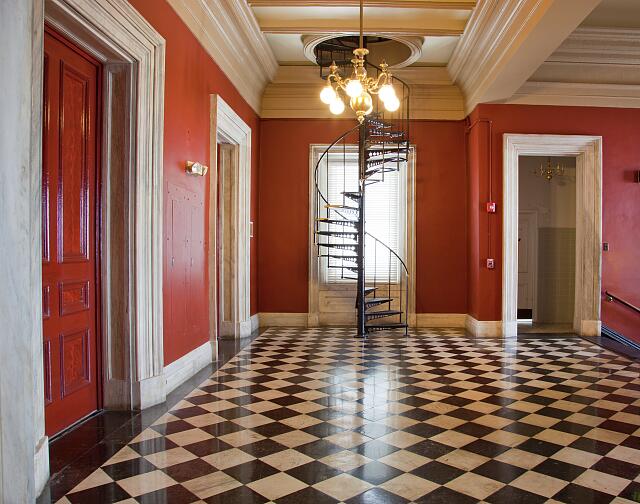
U.S. Custom House History and Background
Charleston’s U.S. Custom House stands as one of the city’s most imposing civic buildings and a powerful expression of Classical Revival architecture, a style rooted in the forms and ideals of Ancient Greece and Rome. Popular in the United States during the 19th century, Classical Revival architecture conveyed permanence, order, and democratic ideals through its use of monumental scale, symmetry, grand columns, and classical detailing.
Designed by Ammi B. Young, the Supervising Architect of the U.S. Treasury, the Custom House reflected a desire to assert authority and stability in one of the nation’s most important port cities. Construction began in 1853, but progress was interrupted by the Civil War, leaving the building unfinished for nearly two decades. Work resumed in 1870 under revised plans that adapted the original design to postwar realities, and the building was ultimately completed as a monumental presence on East Bay Street, anchoring Charleston’s waterfront civic landscape. For much of its history, the Custom House served as a center of federal activity, housing customs operations critical to the city’s maritime economy.
In the mid-20th century, changing attitudes toward historic buildings placed it at risk of demolition, but preservation advocacy helped secure its survival. Today, the Custom House is recognized as a contributing landmark within the Charleston Historic District and is listed on the National Register of Historic Places, standing as a lasting symbol of Charleston’s architectural history and role in American history.

Further reading and resources about the Custom House:
- Charleston: The Place and the People by Beatrice St. Julien Ravenel
A foundational work that situates Charleston’s major civic buildings within the city’s broader social, economic, and architectural development. - Buildings of Charleston by Jonathan H. Poston
Widely regarded as the definitive architectural guide to the city, offering scholarly yet accessible analysis of Charleston’s historic buildings. - The Buildings of Charleston: A Guide to the City’s Architecture by Jonathan H. Poston
An expanded and updated edition that provides deeper architectural context, including federal and Classical Revival structures. - This Is Charleston by Robert N. Rosen
A cultural history that places Charleston’s civic institutions and public architecture within the city’s evolving identity. - Preserving Charleston’s Past, Shaping Its Future, compiled by Historic Charleston Foundation
A scholarly compilation documenting Charleston’s preservation movement, including mid-20th-century threats to historic landmarks and the advocacy efforts that helped save them. - The Architecture of the South Carolina Lowcountry by R. A. Brockington
A regional architectural study that contextualizes Classical Revival civic buildings within broader Lowcountry traditions.