


Indigo: Variations in Blue at the Aiken-Rhett House

.jpeg)
Few colors carry as much history as indigo, and few places feel that weight more than Charleston. Once the crop that defined the Lowcountry economy at an immense human cost, indigo returns to one of Charleston's most extraordinary historic spaces in a new, original art exhibition at the c. 1820 Aiken-Rhett House.
Indigo: Variations in Blue, thoughtfully curated by Tushara Bindu Gude, Ph.D., brings together eight artists of varied backgrounds and training to explore indigo as color, pigment, dye, idea, inspiration, and catalyst of memory. The result is a powerful meditation on the weight of history, expressed through art in every shade of blue imaginable.
What makes this exhibition especially remarkable is the community at its center. All eight artists have, at some point, worked with one or more of the others, whether growing indigo, processing pigments and dyes, sharing knowledge and materials, or collaborating in creative acts. Five of them, Arianne King Comer, Hank Herring, Precious Jennings, Monique de La Tour, and Jim Martin, live and work in Charleston and the surrounding region. The other three, Amina Ahmed, Nyugen E. Smith, and Genesis Tramaine, are based in New Jersey but spent considerable time in Charleston as artists-in-residence at the Foundation for Spirituality and the Arts. Together, they represent diverse ancestries and migrations that parallel the historical pathways of indigo itself.
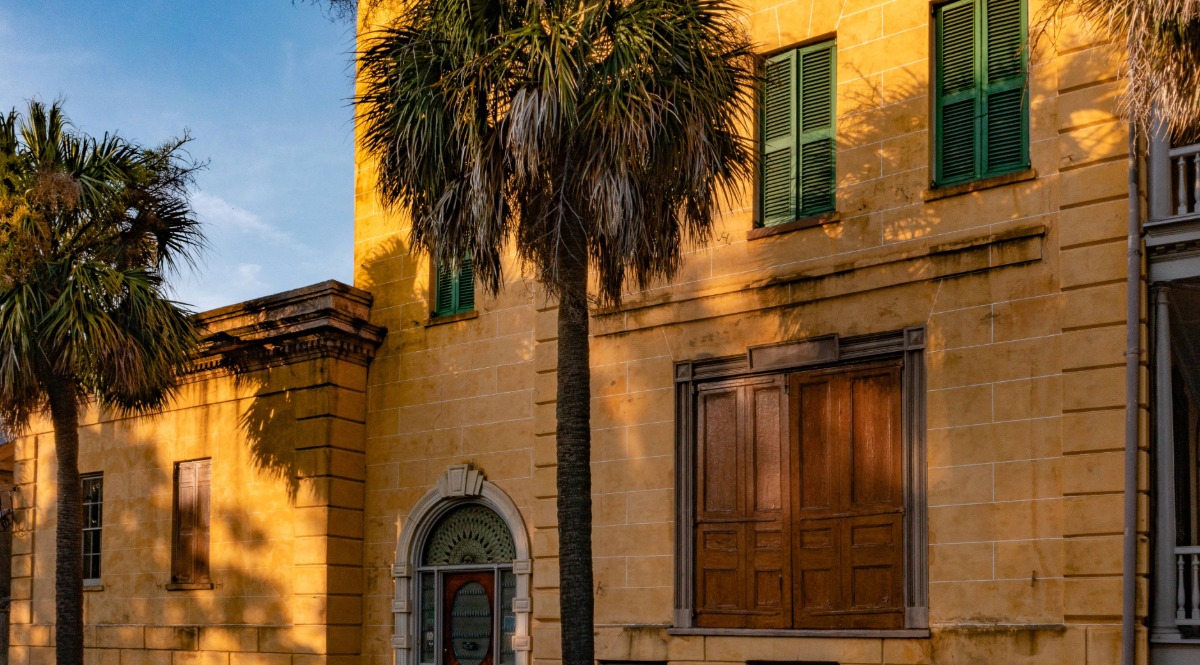
The Aiken-Rhett House is itself a rare thing: a preserved “as-found” 19th-century urban town house and one of the best-preserved examples of the antebellum South's architectural and cultural history and within its walls, the art has a certain poignancy. The artwork inspired by indigo installed throughout the site speak to the transregional and transoceanic networks that shaped Charleston and its environs, though at immense human cost.
Indigo: Variations in Blue is part of The Charleston Festival and Charleston by Design 2026, Historic Charleston Foundation's annual fundraisers celebrating Charleston's history, architecture, culture, and people, running March 13 through April 11, 2026. The exhibit will remain up through June 28 and is available for view with museum admission.
About the Curator
Tushara Bindu Gude, Ph.D. is an independent curator and art historian based in Charleston, South Carolina, and Curator at the Foundation for Spirituality and the Arts. From 2006 through 2022, she served as Associate Curator of South and Southeast Asian Art at the Los Angeles County Museum of Art (LACMA), where her major exhibitions included The Jeweled Isle: Art of Sri Lanka (2018–19), the first comprehensive exhibition on the island organized in the United States, and India's Fabled City: The Art of Courtly Lucknow (2010–11). She received her BA, MA, and PhD in Art History from UCLA.
About the Artists
- Amina Ahmed (b. 1964, Uganda; lives and works in New Jersey) is a multidisciplinary Muslim artist of Kutchi-Indian, Turkic, and Nubian heritage working across painting, printmaking, bookmaking, and textiles. Her practice is rooted in spiritual expression, using pattern and color as a visual language to explore universal connections and trace the story of indigo through her ancestral lineage. Ahmed grew up in England, where she studied at Winchester School of Art and Chelsea School of Art before earning an MA in Visual Islamic and Traditional Arts from the Royal College of Art. She was an artist-in-residence at the Foundation for Spirituality and the Arts in Charleston. Her work has been exhibited at institutions including the Queens Museum of Art (NY) and Nottingham Contemporary (UK).
- Arianne King Comer (b. 1945, CA; lives and works on Wadmalaw Island) is a master dyer and artist known for her hand-drawn and batik indigo textiles. She first learned batik during her BFA studies at Howard University and deepened her connection to indigo and her own Yoruba ancestry through a UN/USIS grant that brought her to Oshogbo, Nigeria, where she studied under renowned batik artist Nike Davies-Okundaye. A dedicated advocate for indigo arts, King Comer serves on the board of the International Center for the Indigo Culture (ICIC), and her work is held in the collections of the Smithsonian Institution, among others.
- Hank D. Herring (b. 1956, North Carolina; lives and works in Beaufort, SC) centers his practice around the manipulation of metals, wood, and reclaimed materials, shaped in large part by a twenty-year career as a machinist in the U.S. Marine Corps. His artworks draw on West African conceptual symbols, and he hand-carves adinkra printing blocks used by artists across the country. A passionate arts advocate, Herring has served in the Kennedy Center's Teaching Artist Program and on the board of the South Carolina Arts Alliance.
- Precious Jennings (b. 1981, Iowa; lives and works in Charleston) is an interdisciplinary performance artist whose practice spans bodywork, dance, textile arts, and sustainable agriculture. She is the founder of Align the Fibers, a collaborative network integrating ecology and sustainable agricultural practices with the visual and performing arts. Jennings first began working with indigo in Charleston and now serves as a consultant to area growers on its cultivation and processing. She is an adjunct professor in the Theater and Dance Department at Columbia College, Chicago.
- Monique de La Tour (b. 1964, New Zealand; lives and works on St. Helena Island) works across textile design, graphic design, illustration, painting, and photography, with a strong commitment to community building, sustainability, and reverence for the natural environment. Her roots in the indigenous land of Te Urewera in New Zealand and years spent among rural communities in Jamaica inform her deep connection to natural pigments and dyes. She currently serves as Exhibition and Interpretive Lead at Penn Center, one of the first schools established for formerly enslaved children, and received her BA in textile design from the Royal Melbourne Institute of Technology.
- Jim Martin (b. 1963, Ohio; lives and works in Charleston) pursues the art of gardening alongside photography, floral arts, and encaustics. His investigation of indigo cultivation and processing led him to organize Indigo in Bloom in 2025, an intervention placing indigo textiles, sculptures, and installations throughout the gardens at Magnolia Plantation and Gardens, where he serves as Director of Horticulture. Martin received his BS in Ornamental Horticulture from Clemson University and brings more than thirty-five years of horticultural leadership to his art practice.
- Nyugen E. Smith (b. 1976, New Jersey; lives and works in New Jersey) is known for visually complex explorations of African diasporic histories, incorporating considerations of colonialism, slavery, linguistics, cartography, and global migration into a multidisciplinary practice spanning painting, sculpture, installation, performance, and spoken word. Born to parents of Trinidadian and Haitian origin, Smith first allied indigo to his practice during a 2025 residency at the Foundation for Spirituality and the Arts in Charleston. His work has been presented at the National Museum of African American History and Culture, the International African American Museum in Charleston, the Pérez Art Museum in Miami, and many others. He holds a BA from Seton Hall University and an MFA from the School of the Art Institute of Chicago.
- Genesis Tramaine (b. 1983, New York; lives and works in New Jersey) is a self-taught artist and self-described “devotional painter” known for striking expressionist portraits of Black subjects inspired by her Christian faith. Her paintings use color, line, and inscribed text to convey meaning, narrative, and emotion with extraordinary force. Tramaine studied indigo with Baltimore-based fiber artist Kibibi Ajanku and deepened her practice during a 2025 residency in Charleston at the Foundation for Spirituality and the Arts. Her work resides in the collections of the National Gallery of Art and the Hirshhorn Museum (Washington, DC), the Crystal Bridges Museum of American Art, and the Buffalo AKG Art Museum, among others.
Select works of art will be available for purchase, with a portion supporting HCF's mission and stewardship of the Aiken-Rhett House Museum. Programs and tours to accompany this exhibition TBA.