


Recommendations from the Preservation Community: Addressing Demolition by Neglect

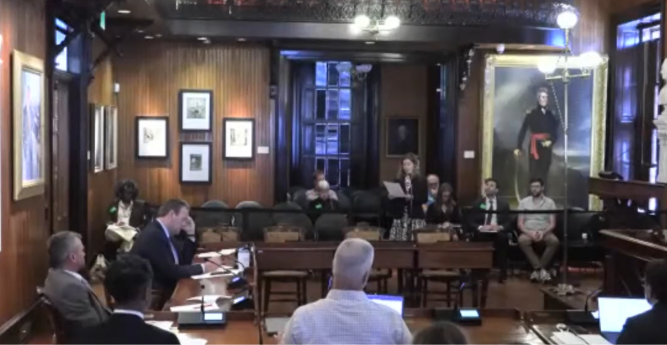
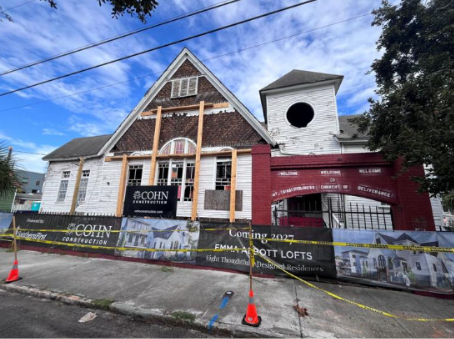
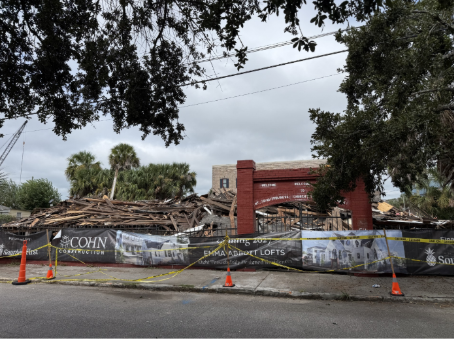
How can Charleston prevent the loss of historic buildings like 52 Cooper Street to demolition by neglect? That question was at the center of the City of Charleston’s Community Development Committee meeting on October 22, where committee members discussed potential process improvements to better protect the city’s historic resources.
Historic Charleston Foundation (HCF), alongside our partners at Save Our Structures Charleston (SOS-CHS) and the Preservation Society of Charleston (PSC), shared our collective goals and proposed solutions to help prevent demolition by neglect and preserve Charleston’s historic buildings for future generations.
Joint Recommendations
The City has the opportunity to send a strong message to property owners and developers affirming that Charleston’s character-defining historic buildings are irreplaceable community assets and essential to protecting the city’s heritage. The following recommendations provide policy solutions to proactively prevent “demolition by neglect” (DbN) and strengthen accountability when loss of significant historic resources occurs.
DbN is the practice of allowing a building to deteriorate through failure to maintain it. DbN can be willful or unwilful and is driven by a variety of complex factors.
Goal #1: Resolve communication and coordination challenges between city departments and the public.
Problems arise when the City’s chief building official (CBO) finds a building is a threat to public safety (e.g., by collapsing into the street) and bypasses the BAR, unilaterally ordering demolition. (Sec. 7-71 to 7-124) While public safety demolitions are important in some exigent cases (e.g., a car crashes into a corner building), ordinance revisions should ensure the CBO’s authority does not extend to demolitions in cases of DbN where nothing has suddenly changed. Not only are those cases not true exigencies, altering the normal approval process eliminates the eyes of the public and informed preservationists who might otherwise challenge the existence of a safety risk.
Solution #1: Require that public safety demolitions involve confirmed unforeseeable and sudden changes to structures.
The City Code should be amended to specify that the CBO may unilaterally bypass the BAR only after the CBO certifies an exigency caused by a sudden and unforeseeable change in the building’s condition. Moreover, the CBO should consult with an independent, licensed engineer to confirm claims made by owners and solicit input from other interested parties. In cases where immediate action is not justified, any supposedly unsafe building would be added to the next BAR agenda, exceeding the normal cap on agenda items if necessary.
To ensure thorough vetting of claims about a building’s condition, notice should be provided to the Mayor, neighborhood associations, City Council members representing those neighborhoods, preservation advocacy organizations, and other stakeholders, as well as posted in a conspicuous location on the subject property.
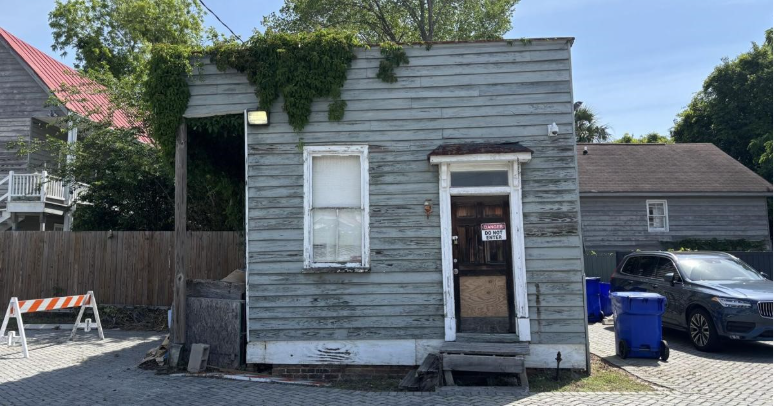
Goal #2: Change demolition standards so that they are based on comprehensive value to Charleston’s history, culture, and streetscape.
The City Code already provides that the CBO can order demolition or stabilization of “uninhabitable” buildings on behalf of recalcitrant owners. (Sec. 7-94) The standard for pursuing such work is tied only to the financial context and does not refer to history, cultural import, or aesthetics; repair work can be ordered only “[i]f the repair, alteration or improvement of such dwelling can be made at a reasonable cost in relation to the value of the dwelling.” (Sec. 7-94(1)) However, in evaluating demolition requests, the BAR must balance “the historic, architectural and aesthetic features of such structure, the nature and character of the surrounding area, the historic or culturally important use of such structure and the importance to the city.” (Sec. 54-520)
Solution #2: Amend Sec. 7-94 to expand the standards for safety-related demolitions.
The standard for CBO demolition or stabilization approval should be amended to include the factors beyond pure economics. For example, by adding the same factors used by the BAR, a house might be stabilized when the history, streetscape, or architecture overrides the purely economic assessment of the cost of repairs. As the City adds new information about its cultural heritage in future surveys, that could also be weighed with broader, more flexible standards. Adding in the extra factors would make it easier for the City to justify rehabilitation, while making demolition harder to justify.
Goal #3: Make demolition a difficult choice.
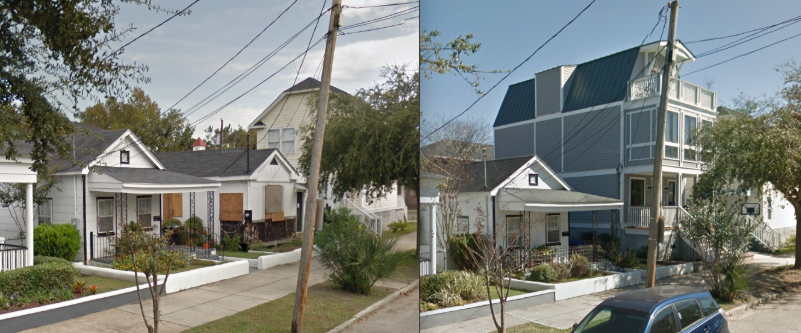
Outside the “Old City District,” BAR approval of demolition is needed, but not for alterations or new construction. If a building collapses outside the Old City District, the land is free of any obligation to reproduce the original building, no matter how culpable the owner was.
Solution #3: If a building is ordered down by the CBO or demolished without appropriate BAR approvals, the parcel should be subject to subsequent design review.
Broadly, the City should expand the BAR’s jurisdiction to more of the upper peninsula. In the meantime, at least for cases of DbN, the City should expand BAR oversight on a case-by-case basis. In 2025, the City adopted an opt-in BAR review by which an owner may voluntarily submit to more expansive BAR review including alterations and new construction. In cases of successful DbN, the parcel should be automatically added to the Old City District so that the BAR can guide accurate reconstruction or otherwise compatible infill.
Goal #4: Preserve historic material when demolition occurs.
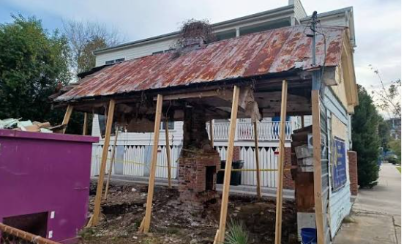
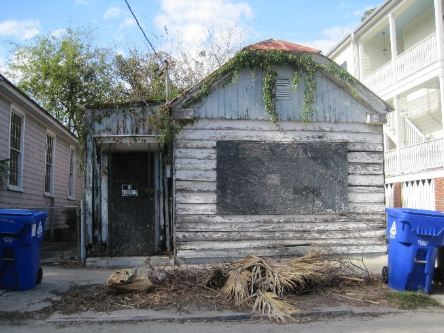
When the BAR or CBO approves or orders demolition, salvageable historic material is often needlessly lost. Retaining historic materials and architectural features allows Charleston’s rich craftsmanship traditions to remain visible and accessible as educational resources, while also reducing construction waste and supporting environmental sustainability.
Solution #4: Adopt a deconstruction and salvage ordinance.
Adopt a deconstruction and salvage ordinance that requires or incentivizes the careful dismantling of buildings that are approved for demolition. Comparable programs have been successfully implemented in communities across the country to maximize recovery and reuse of historic building materials.
As an initial step, the City could require a pre-demolition salvage assessment for historic structures. A deconstruction and salvage ordinance would prioritize reuse of salvaged historic materials on-site or available to local homeowners for critical repairs through reduced-cost sales or donation programs.
Goal #5: Prevent unwilful neglect by assisting property owners.
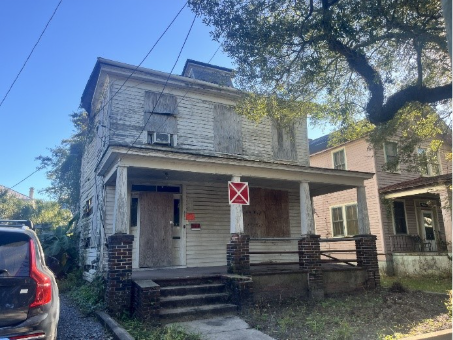
“Heirs’ property” describes unclear property titles caused by a lack of probate over one or more generations. When a person dies, title to the decedent’s real property passes immediately. With each generation, the title becomes even more divided to the point that ownership can be just 1% or 2%.
Without clear title, even eager owners cannot get financing for work because banks won’t accept clouded titles to secure loans. Tax credits and FEMA funding are also unavailable. And the City lacks a clear target for enforcement actions when the title is unclear.
Solution #5: Assist willing owners with resolving clouded titles through a collaboration with the Centers for Heirs’ Property and the Charleston School of Law.
The Charleston School of Law is attempting to create a legal clinic in cooperation with the Center for Heirs’ Property. The clinic would train law students to resolve the Gordian Knots affecting many generational houses in downtown Charleston and work with owners on a pro bono basis to settle ownership. The City Legal Department is interested in working with the program to supply a list of projects where heirs’ property has interfered with resolving DbN. Additionally, the City could fund such a clinic and assist in teaching the clinic by providing guest lecturers about the real-world consequences of clouded title.
Goal #6: Improve enforcement of existing policies.
When a building becomes uninhabitable—which requires only that the utilities have been cut, among other things—the City has the power to step in and stabilize or repair the structure. Any cost to the City is secured with a lien. Throughout the aforementioned code sections, repairs, alterations, or improvements are consistently cited as the first course of action before resorting to demolition.
Additionally, Sec. 54-241 empowers the BAR, on its own initiative, to “file a petition with the CBO requesting . . . to require correction of defects or repairs to any structure covered by this article so that such structure shall not experience demolition by neglect and be preserved and protected in consonance with the purpose of this article and the public safety and housing ordinance.”
Solution #6: Make more effective use of staff resources to enforce existing preservation processes.
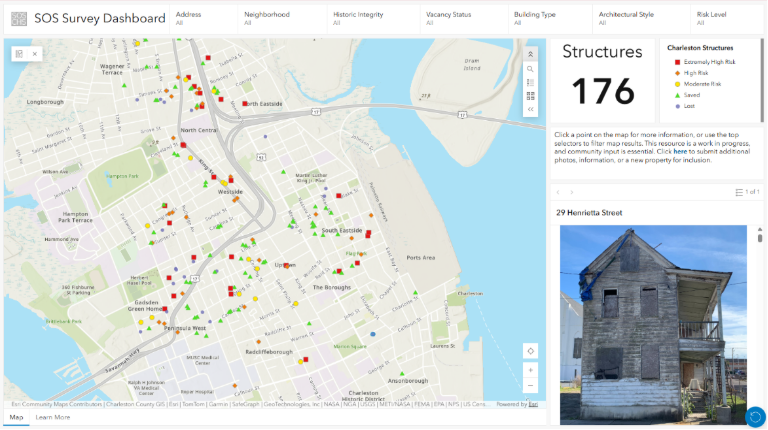
One of the PO’s greatest strengths is that it already provides avenues by which the City can prevent DbN. Existing assessments and rankings of the most threatened buildings already exist without the need for any additional surveys or studies.
The City can strengthen enforcement through closer coordination between the Planning, Permitting & Engineering and Livability & Tourism divisions. While the Department of Preservation & Planning has limited enforcement capacity, Livability code enforcement officers are in the field daily and could help identify and address cases of DbN more consistently and proactively through improved interdepartmental collaboration. The Livability Review Board is an existing forum for convening multiple city departments, property owners, and preservationists to discuss at-risk properties.
By consistently applying the ordinance’s existing provisions, City staff can play a critical role in protecting vulnerable historic resources and encouraging meaningful rehabilitation efforts.
During the October 22 Community Development Committee meeting, City staff presented their recommendations for improving processes related to vacant and at-risk properties. The proposed improvements included the following:
Imediate Actions (1-3 Months):
- Develop Clear Procedures and guidance. Formalize existing coordination between relevant city staff and reconvene the demolition by neglect task force. Connect property owners with resources and provide clear language on city processes for helping property owners.
- Improve coordination and data sharing. Refine and regularly update the database of at-risk buildings. Categorize, score, and prioritize properties by condition, historic significance, ownership, and safety risk. Add representation from preservation groups to livability board and collaborate with preservation organizations
- Improve communication and notification procedures for notice of violation letters.
- Advance bloomberg/City of Charleston project to address vacant and at risk historic buildings
Near-term actions (6-9 Months):
- Strengthen enforcement and oversight.
- Explore funding sources
- Implement Bloomberg and demolition by neglect task force recommendations
The committee raised concerns about identifying adequate funding sources and the significant costs associated with stabilizing some structures. Potential solutions could include establishing a matching grant program to support the rehabilitation of abandoned properties or creating a revolving fund to help finance stabilization and restoration efforts.
Clearing heirs’ property title is another important component of addressing the issue and could help facilitate rehabilitation. Even a relatively small investment by the City could have a meaningful impact in helping move properties toward stabilization and preservation.
The committee also discussed how to address demolition by neglect, particularly in cases involving negligent property owners. Key questions remain about how to define willful neglect, establish intent, and determine appropriate enforcement measures. The City’s concerns about potential liability must also be considered when developing solutions.
Ultimately, this is a complex issue that will require sustained coordination and collaboration among property owners, the City, and historic preservation stakeholders to identify effective, equitable, and practical strategies for protecting at-risk historic buildings. No motions were made regarding this agenda item during the committee meeting.
Continuing the Work to Prevent Demolition by Neglect
Historic Charleston Foundation and our preservation partners appreciate the Community Development Committee’s interest in working with our organizations and Charleston residents to address this longstanding issue.
We jointly encouraged the Committee to consider the goals and proposed solutions outlined above and advance potential implementation strategies and policy recommendations for City Council’s consideration.
We remain committed to working together to protect Charleston’s historic buildings, strengthen preservation processes, and prevent the avoidable loss of the places that define our city.
The time to act is now.